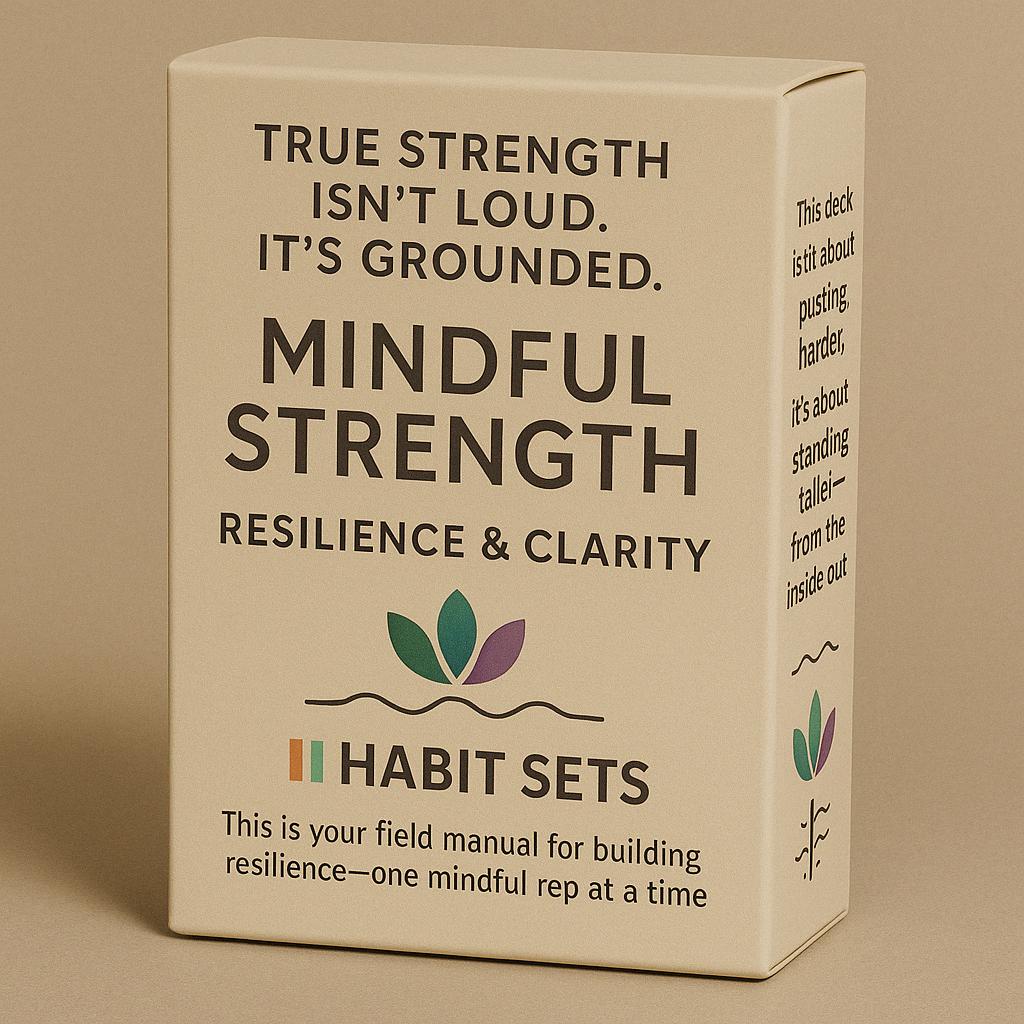
Periodic Table of Habits
Take 3 slow, deep breaths before getting out of bed. Start your day centered, not scattered.
Pause and identify one feeling you're experiencing right now. Naming it helps manage it.
Take one sip of water, noticing the temperature and sensation fully. Hydrate your body and mind.
Pause and intentionally listen for three distinct sounds around you. Anchor yourself in the present.
Choose one task and focus solely on it for five minutes. Build your attention muscle.
Do one simple stretch, like reaching up or touching toes, mindfully. Release physical tension.
Notice a thought arise without judging or engaging it, like a cloud passing. Cultivate detachment.
Bring awareness to the sensation of your feet connecting with the floor. Ground yourself instantly.
Mentally acknowledge one thing you're grateful for right now. Shift your focus to positivity.
Briefly scan your body for areas of tension (jaw, shoulders, brow). Acknowledge without judgment.
Shut your eyes for one minute to reduce sensory input. Offer your mind a brief rest.
Savor the first bite of your meal, noticing taste, texture, smell. Anchor in the present.
Intentionally slow your walking pace for 60 seconds, noticing movement. Counteract habitual rushing.
Pick a color nearby and truly notice its shade and variations. Focus your visual attention.
Notice any physical sensation (itch, ache, warmth) without reacting. Practice acceptance.
Consciously place your phone face down for a few minutes. Reclaim your attention.
Give someone your complete, undivided attention for 30 seconds. Practice presence in connection.
Feel the sensation of air entering and leaving your nostrils. Anchor in the breath.
Offer yourself a small, gentle smile, perhaps in the mirror. Cultivate self-kindness.
Pick up an object and focus entirely on its texture. Engage your sense of touch.
Choose one word (e.g., 'Calm', 'Focus', 'Kindness') as your intention now. Set your inner compass.
Look outside and notice the weather without judgment (sun, rain, wind). Accept what is.
Hum a simple tune quietly to yourself for a moment. Soothe your nervous system.
Place a hand on your chest and feel your heartbeat for a few seconds. Connect with your vitality.
Gaze out a window for a minute, letting your eyes rest softly. Broaden your perspective.
Identify something solid and stable in your environment (floor, wall, desk). Reinforce groundedness.
Briefly bring to mind a peaceful memory, focusing on the feeling. Access inner resources.
Acknowledge an impulse (e.g., check phone, snack) without immediately acting. Practice mindfulpausing.
Notice your posture right now and make a small, kind adjustment. Align body and mind.
Make your next exhale slightly longer than your inhale. Activate relaxation response.
Notice and appreciate something mundane (e.g., warm mug, pen). Cultivate everyday gratitude.
Consciously relax your jaw, letting your teeth part slightly. Let go of hidden stress.
Notice the sensation of your hands resting, wherever they are. Anchor in stillness.
Feel the sensation of air touching your exposed skin (face, hands). Engage subtle senses.
Mentally state one simple, objective fact about your surroundings. Ground in reality.
Take a single step, noticing the movement and contact with the ground. Be fully present.
Notice a self-critical thought and silently say 'I hear you'. Disarm it with gentle awareness.
Bring awareness to the sensation of your clothing touching your skin. Ground in tactile input.
Take one conscious breath before hitting 'send' or 'reply'. Choose clarity over reactivity.
Observe clouds drifting across the sky for a minute. Practice detached observation.
Intentionally notice one pleasant aroma in your environment. Engage your sense of smell.
Become aware of any changes in your body temperature (warmth, coolness). Tune into subtle sensations.
Check if your hands are clenched and consciously relax them. Release physical bracing.
Silently wish someone well (friend, stranger, self). Cultivate positive connection.
Name 5 things you see, 4 you feel, 3 you hear, 2 you smell, 1 you taste. Anchor in senses.
Write down a recent situation that triggered you and your reaction. Increase self-awareness.
Systematically bring awareness to different body parts for 5 mins. Connect mind and body.
Review recent thoughts and identify one thinking error (e.g., catastrophizing). Challenge unhelpfulpatterns.
Take a negative thought and consciously find a more balanced perspective. Shift your internalnarrative.
Start your day by mindfully setting an intention for how you want to be or act. Guide your focus.
Write down or mentally list three specific things you're grateful for today. Enhance positive focus.
Choose a 5-minute part of your commute to be fully present (walking, driving, transit). Anchor in thejourney.
When wanting something instantly (snack, purchase), wait 5 minutes mindfully. Build impulse control.
When feeling upset, ask 'What need is not being met right now?' (e.g., rest, connection). Gain emotionalinsight.
In difficulty, say 'This is a moment of suffering. Suffering is part of life. May I be kind to myself.'Soothe yourself.
Identify an emotion and rate its intensity (1-10). Increase emotional granularity.
Sit for 5 minutes focusing on your breath or a chosen anchor. Build consistent focus.
Visualize difficult emotions as weather clouds passing through the sky of your awareness. Practicenon-identification.
Externalize one worry by writing it down specifically. Contain anxious thoughts.
Observe judgmental thoughts (of self/others) arise without acting on them. Cultivate non-judgmentalawareness.
Intentionally plan a brief mindful pause between two activities (e.g., work/home). Manage energyshifts.
Walk for 10 minutes focusing on body sensations or surroundings. Integrate mindfulness into movement.
Pause briefly during a task to notice your breath, body, and focus level. Regain presence.
Reflect on and name one of your character strengths (e.g., kindness, perseverance). Acknowledge yourresources.
Intentionally complete one small task 'good enough' instead of perfectly. Challenge perfectionism.
Repeat phrases like 'May I be safe, may I be healthy...' for self/others. Cultivate compassion.
Notice physical or emotional discomfort and breathe gently 'into' the sensation. Practice acceptance.
Reflect on your energy/commitments and identify one boundary you need to set. Protect your resources.
When lost in thought during mindfulness, gently label it 'thinking'. Return to anchornon-judgmentally.
Acknowledge one thing you did well or achieved today, however small. Build self-efficacy.
Engage fully in the process of preparing a meal, noticing sights, sounds, smells, textures. Findpresence in routine.
In one conversation today, focus solely on listening without interrupting. Practice deep listening.
Notice when you use 'should' or 'shouldn't' about yourself/others. Question rigid expectations.
Instead of judging a feeling, ask 'What does this feel like in my body?' Explore with curiosity.
Acknowledge your feeling/experience as valid, e.g., 'It makes sense I feel tired'. Offer internalsupport.
Become aware when your mind starts replaying negative thoughts or events. Catch the loop early.
Intentionally choose what media you consume for a period, avoiding mindless scrolling. Curate yourinput.
Apply Recognize, Allow, Investigate, Nurture (RAIN) to a difficult emotion. Process with compassion.
Choose one core value (e.g., connection) and identify one small action aligned with it. Live yourvalues.
Pause when feeling stressed or depleted and ask yourself 'What do I truly need right now?' Tune intoself-care.
Commit to a daily 20-minute meditation practice (choose technique). Deepen mindful awareness.
Engage in a conversation aiming only to understand the other person, without formulating your reply.Cultivate deep presence.
Choose a manageable fear and approach it with mindful awareness of sensations/thoughts. Expand comfortzone.
Dedicate time weekly to reflect on and clarify your core life values. Align life with purpose.
When stressed, intentionally pause, breathe, and choose a thoughtful response over an automaticreaction. Master self-regulation.
Engage in a detailed, slow body scan meditation for 15 mins or more. Deepen interoceptive awareness.
Fully accept reality in a difficult moment, without resistance or judgment. Embrace 'what is'.
Approach a necessary but challenging conversation with presence, empathy, and clear boundaries. Navigateconflict constructively.
Notice your mind's protective mechanisms (denial, blaming, justification) in real-time. Increaseself-awareness.
Trace a recurring emotional reaction back to an underlying core belief. Uncover root causes.
Maintain awareness as the 'observer' of thoughts, feelings, sensations, without identifying. Cultivatepure awareness.
Intentionally maintain internal balance and non-reactivity during external stress or turmoil. Anchor ininner calm.
Explain a mindfulness principle or technique simply to someone else. Solidify your understanding.
Consider two conflicting ideas or perspectives simultaneously without needing to resolve themimmediately. Tolerate ambiguity.
Engage in a formal or informal forgiveness practice for a past hurt. Release resentment.
Notice when you 'catch' someone else's mood and identify the source/interaction. Increase emotionaldifferentiation.
Apply mindfulness principles (presence, empathy, non-reactivity) throughout a conflict resolutionprocess. Seek win-win outcomes.
Intentionally maintain concentration on a task despite internal or external distractions. Strengthenattentional control.
Share your mindful strength knowledge and experience to support someone else's journey. Reinforce yourown skills.
Systematically apply mindful pauses, single-tasking, and presence throughout your workday. Work withcalm clarity.
Briefly reflect on your connection to others, nature, or the wider world. Foster perspective andcompassion.
During meditation, intentionally let go of goals or desired outcomes. Simply be present with what is.
Bring to mind someone challenging and intentionally cultivate feelings of compassion for theirsuffering. Expand empathy.
Design and practice a short daily or weekly ritual that combines grounding/centering elements. Anchoryour strength.
Reflect in writing on how your recent actions align (or don't) with your core values. Fosterintegrity.
When facing failure or difficulty, intentionally apply self-compassion practices. Support yourselfthrough adversity.
In a safe context, choose to share something authentic and vulnerable. Build connection and courage.
Approach a familiar task or situation as if for the first time, with openness and curiosity. See thingsanew.
Recognize a limiting narrative you tell about yourself/the world, and consciously choose to let it go.Rewrite your script.
Take a valued action even when feeling fear, anxiety, or discomfort. Build psychological flexibility.
For 7 days, refrain from complaining (verbally or mentally). Reframe or accept instead.
Dedicate one hour each day for 14 days completely free of screens (phone, computer, TV). Reconnect withreal life.
Eat at least one meal each day for 5 days in complete silence, focusing only on the food and eatingprocess.
Write down 3 new things you're grateful for each day for 21 consecutive days. Wire your brain forpositivity.
Meditate for at least 10 minutes every single day for 10 days straight. Build momentum.
For 7 days, actively track each instance you react impulsively vs respond mindfully to stressors.Increase awareness.
Dedicate significant portions of 3 days to intentional silence (e.g., mornings, evenings). Deepen innerlistening.
Actively look for and label at least one cognitive distortion in your thinking each day for 14 days.Sharpen mental clarity.
Intentionally practice a formal self-compassion break (like Neff's) 3 times a day for 5 days. Boostinner kindness.
Choose one core value and take one small action aligned with it daily for 30 days. Live with purpose.